

Notary Public: The Short Answer
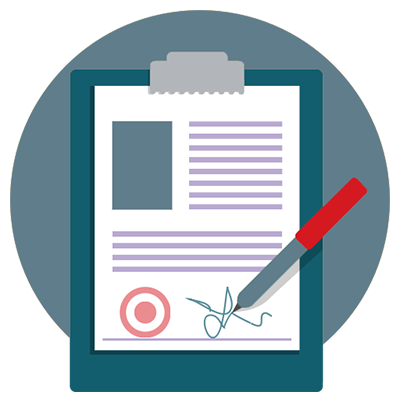
A notary public is an officer of the state who acts as an impartial and credible witness for signing essential documents. Depending upon the jurisdiction, the role of a notart public includes administering oaths as well as other official capacities. Generally, the notary public charges a small fee for their services. They perform their official duties by marking the documents with their signature and seal (a distinctive stamp.) The documents signed and witnessed by the notary public are said to be notarized.
Notary Public: Benefits
There are many benefits to a notary public. It provides an inexpensive method for individuals and companies to enter into agreements by certifying the identities of the parties and the authenticity of the document execution. The signing parties can conduct business freely with an assurance that the court will recognize these documents.
Document notarization requires the signing party to prove his or her identity; therefore, it protects against fraud. Although it is not conclusive proof of identity, it provides substantial evidence of the identity.
They also act as an intermediary for parties entering into a legal contract.

Role of a Notary Public
In the United States, the notary public performs the duties of a notary. The role of a notary public include witnessing the documents and administrating the oaths. In a few states, the notary public can also certify copies of official or legal documents. The most common documents that a notary public deals with are power of attorney and transfer of property. There are other documents as well that a notary public can officially witness, such as affidavits, formal protests, jurats, oaths, and acknowledgments.
Some states like Louisiana, Florida, authorize more duties to the notary public. For example, in Florida, South Carolina, and Maine, a notary public can also solemnize a marriage ceremony. Remember the notary public is an officer of the state.
Becoming a Notary Public
The minimum requirements for becoming a notary public are considerably easy to meet. The minimum age of the applicant must be 18 years. There is also a small fee for the application process in most states. Few states require that the candidate must clear an exam with satisfactory performance for becoming a notary officer. Some states make it mandatory for a notary public to hold a bond as assurance in case there is a lawsuit leveled against the notary.
How SAFEBOX eases the Notary Public workload
Preventing fraudulent signatures and keeping track of all the identity proof served is a crucial part of any notary public. As notary public may work with several clients in a day, keeping track as well as maintaining confidential/private data can become an overwhelming task.
With SAFEBOX, the notary public can save the original document and go worry-free!! They can manage all their records via SAFEBOX, instantly and also efficiently.
Trending Technologies 2020
No Results Found
The page you requested could not be found. Try refining your search, or use the navigation above to locate the post.
Our Latest Updates


Decentralized Applications
As opposed to centralized applications that run on a single computer, decentralized applications run on a P2P network of computers. They have existed since the advent of P2P networks. Decentralized applications don‘t necessarily need to run on top of a blockchain...

Smart Contracts
A smart contract is a self-enforcing piece of so ware that is managed by a P2P network of computers. Smart contracts are e cient rights management tools that provide a coordination and enforcement fra- mework for agreements between network participants, without the...

Which Blockchain?
The Bitcoin White Paper was published by Satoshi Nakamoto in 2008; the first Bitcoin block got mined in 2009. Since the Bitcoin protocol is open source, anyone could take the protocol, fork it (modify the code), and start their own version of P2P money. This...