

Decentralized Applications
As opposed to centralized applications that run on a single computer, decentralized applications run on a P2P network of computers. They have existed since the advent of P2P networks.
Decentralized applications don‘t necessarily need to run on top of a blockchain network. Tor, BitTorrent, Popcorn Time, BitMessage, are examples for decentralized applications that run on a P2P network, but not on a blockchain – which is a special kind of P2P network (read more: Origins of Bitcoin and Web3).
Decentralized applications are a piece of so ware that communicates with the blockchain, which manages the state of all network actors. The interface of the decentralized applications does not look any different than any website or mobile app today. The smart contract represents the core logic of a decentralized application. Smart contracts are integral building blocks of blockchains, that process information from external sensors or events and help the blockchain manage the state of all network actors.
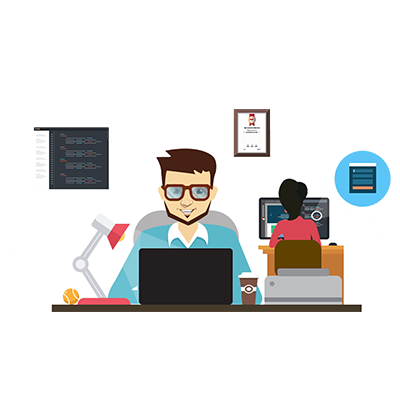
The frontend of a decentralized application represents what you see, and the backend represents the entire business logic. This business logic is represented by one or several smart contracts interacting with the underlying blockchain. The frontend, as well as files like a photo, a video, or audio, could be hosted on decentralized storage networks such as Swarm or IPFS. Traditional Web applications use HTML, CSS, and javascript or the like to render a webpage. This page interacts with a centralized database, where all the data is stored. When you use a service like Twitter, Facebook, Amazon, or Airbnb, for example, the webpage will call an API to process your personal data and other necessary information stored on their servers, to display them on the page. User ID and passwords are used for identification and authentication, with low levels of security, since personalized data is stored on the server of the service provider.
Traditional websites: Front End → API → Database.
Decentralized applications are similar to a traditional Web application. The frontend uses the exact same technology to render the page. It contains a “wallet” that communicates with the blockchain. The wallet manages cryptographic keys and the blockchain address. Public-key infrastructure is used for user identification and authentication. Instead of an API connecting to a database, a wallet so – ware triggers activities of a smart contract, which interacts with a blockchain:
Web3 compatible website:
Front End (including wallet) → Smart Contract → Blockchain.
In contrast to Web2 applications, Web3 applications need a connection to the blockchain, which is managed by a special application called “wallet.” It keeps a record of the private keys and blockchain address, which represents the unique 30 identities and point of reference. Without a so ware that manages our digital identity, we will not be able to interact with the blockchain. The Web3, therefore, builds on the current Web2 stack and introduces additional elements on an application level. In the backend, the Web3 adds a whole new infrastructure layer for decentralized applications to interact with – the decentralized protocol stack. Decentralized apps need to have a component that manages a user’s private keys, with which one can sign transactions on the state layer, the blockchain (read more: Token Security – Cryptography).
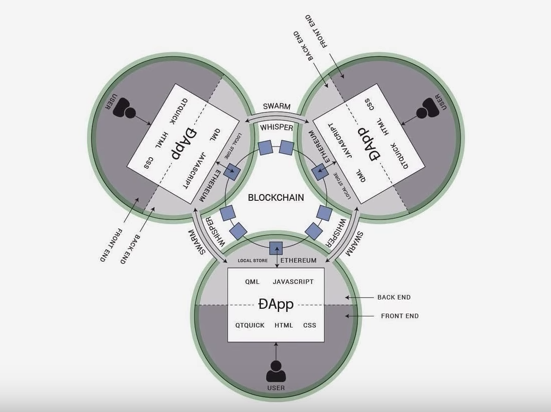
Illustration of a DApp that uses a blockchain with smart contracts combined with the pillars of Swarm and Whisper.
Source: Ethereum Stack exchange
Trending Technologies 2020
No Results Found
The page you requested could not be found. Try refining your search, or use the navigation above to locate the post.
Our Latest Updates


What is Blockchain?
Blockchain builds on the idea of P2P networks and provides a universal data set that every actor can trust, even though they might not know or trust each other. It provides a shared and trusted ledger of transactions, where immutable and encrypted copies of...

Cryptoeconomics
Cryptoeconomics refers to the study of economic interaction in adversarial environments. The underlying challenge is that in decentralized P2P systems, that do not give control to any centralized party, one must assume that there will be bad actors looking to disrupt...

SAFEBOX Instructions
If you are on this page, then you already a step ahead of the rest. Buckle up as we are going to take you into the secure world of the Blockchain system. Lock your documents securely in just six easy steps. Just follow the given SAFEBOX instructions. Subscribe to...